NBI Clearance vs Police Clearance Differences and Uses 2026
Many Filipinos often feel confused when asked to submit an NBI Clearance or a Police Clearance. This NBI Clearance vs Police Clearance guide helps you understand the key differences and usage of both documents. While both documents are used to prove that a person has no criminal record, they are not the same and are accepted for different purposes. Understanding the difference between NBI Clearance vs Police Clearance is important, especially when applying for jobs, visas, travel, or government services in the Philippines and abroad.
Both clearances are issued by different authorities and cover different record scopes. Choosing the wrong one can lead to delays, rejection of applications, or extra costs. Knowing which clearance you need helps you save time and avoid problems.
People usually get confused because:
- Both documents show criminal record status
- Both are required for employment or official use
- Both are issued by government agencies
- Both look similar in purpose but differ in coverage
In this guide, you will clearly understand NBI Clearance vs Police Clearance, their uses, and which one fits your specific needs.
What Is Police Clearance in the Philippines?
Police Clearance in the Philippines is an official document that proves a person has no criminal record within a specific city or municipality. It is issued by the Philippine National Police (PNP) through local police stations. This clearance is commonly used for local purposes such as employment, school requirements, or local permits. Visit here for further guidance on the application for a police clearance certificate.
Unlike national background checks, Police Clearance Philippines only verifies records within the area where it is issued. It does not search nationwide databases, which limits its coverage. Because of this, it is suitable only for local use and not for overseas jobs or immigration.
Key features of Police Clearance include:
- Issued by the Philippine National Police
- Covers records within one city or municipality
- Faster and simpler than national clearances
- Common Police Clearance requirements include a valid ID and personal details
Uses of Police Clearance
Police Clearance is an official document used to prove that a person has no criminal record within a specific area. It is accepted in many daily and legal transactions, especially at the local level. Understanding Police Clearance uses can help you know when and where it is required. One of the most common Police Clearance uses is Police Clearance is for local jobs, where employers need basic background verification. It is also widely accepted by local government offices for simple processes and permits.
Common situations where Police Clearance is used include:
- Local employment and short-term job applications
- Barangay transactions and residency verification
- Small business permits and renewals
- City or municipal-level documentation
- School, training, or internship requirements
What Is NBI Clearance in the Philippines?
NBI Clearance is an official document issued by the National Bureau of Investigation in the Philippines. It proves whether a person has a criminal record anywhere in the country. The NBI Clearance Philippines system checks your name against a nationwide database, not just one city or province.
This document is often required as part of NBI Clearance requirements for work, travel, and legal purposes. During the check, the system may show a “hit.” A hit means your name matches someone with a record or a similar name. It does not always mean you committed a crime. The NBI simply needs to verify your identity before releasing the clearance.
- Key document issued by the National Bureau of Investigation
- Nationwide criminal record verification
- Used as proof of good conduct
- A “hit” means name matching, not automatic guilt
Uses of NBI Clearance
NBI Clearance is required in many important situations in the Philippines and abroad. It is used to confirm your identity and background for official and legal processes. Many employers and government offices ask for it as part of their screening.
One of the most common NBI Clearance uses is employment, especially for sensitive roles. It is also important for people planning to work overseas. NBI Clearance for jobs abroad is often mandatory for visa and immigration approval.
- Bank and private company employment
- Overseas employment and foreign visa processing
- Passport application and renewal
- Government jobs and civil service requirements
- Court cases, legal documents, and immigration records
Key Differences Between NBI Clearance and Police Clearance
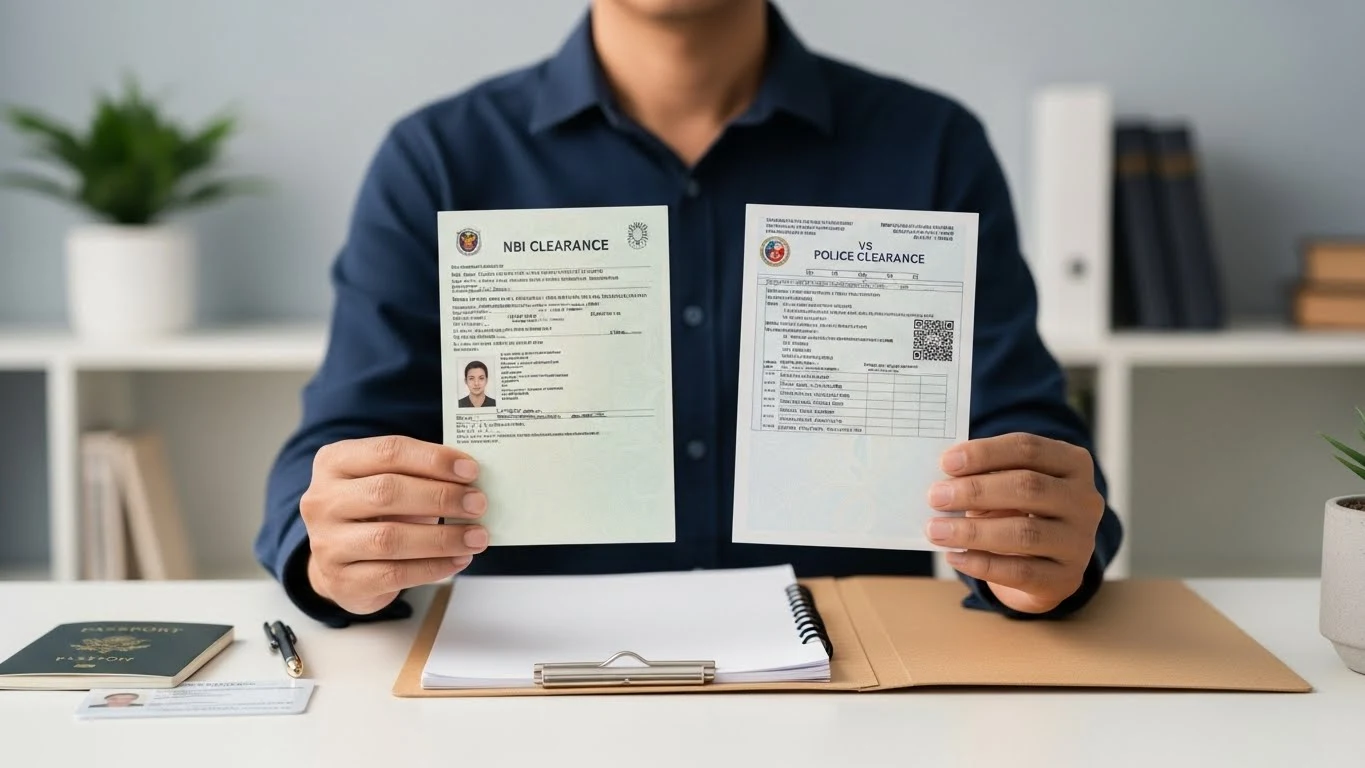
When comparing NBI Clearance vs Police Clearance, the main differences lie in scope, authority, and acceptance. Both documents prove that a person has no criminal record, but they serve different purposes.
The difference between NBI Clearance and Police Clearance starts with the issuing office. NBI Clearance is issued by the National Bureau of Investigation, a national agency. Police Clearance is issued by the local city or municipal police station.
NBI Clearance has a wider scope. It checks records nationwide, while Police Clearance only checks local records. Because of this, NBI Clearance is more widely accepted for jobs abroad, visa applications, and government transactions. Police Clearance is usually accepted for local employment and community-level requirements.
Processing time also varies. Police Clearance is often faster and can be released on the same day. NBI Clearance may take longer, especially if there is a name match or “hit.” Validity also differs, with NBI Clearance valid for one year and Police Clearance usually valid for six months.
| Feature | NBI Clearance | Police Clearance |
|---|---|---|
| Issuing office | National Bureau of Investigation | Local police station |
| Scope | Nationwide record check | Local record check |
| Acceptance level | National and international | Mostly local |
| Processing time | Longer if with hit | Usually same day |
| Validity | One year | Six months |
| Common requirements | Valid ID, biometrics | Valid ID, local records |

NBI Clearance vs Police Clearance: Which One Should You Get?
Choosing between NBI Clearance vs Police Clearance depends on why you need the document. Both prove you have no criminal record, but they serve different purposes. An NBI Clearance is nationwide and checked against a central database. A Police Clearance is local and issued by your city or municipal police station.
If your purpose involves national or international use, the NBI Clearance is usually required. If you only need proof for a local request, a Police Clearance is often enough. Understanding where and how the clearance will be used helps you avoid delays, extra costs, and repeat applications.
Below is a simple guide to help you decide which clearance fits your situation.

Get an NBI Clearance If
If you are unsure which is better NBI or Police Clearance, choose NBI Clearance for official and high-level requirements, such as:
- Overseas employment or work abroad
- Visa and immigration applications
- Requirements from national government agencies
- Job applications with large corporations
- Purposes that require nationwide background checks
NBI Clearance is widely accepted and trusted for formal and long-term use.
Get a Police Clearance If
A Police Clearance is suitable when the Police Clearance application process is needed for simple, local matters, including:
- Local job applications
- Barangay or city-level requirements
- School or internship purposes
- Short-term or urgent documentation needs
It is faster to get and ideal for community-based or city-specific use.
Cost Comparison: NBI Clearance vs Police Clearance
When comparing NBI Clearance vs Police Clearance, cost is an important factor for many applicants. Both documents are affordable, but they differ slightly in price and overall value.
| Clearance Type | Average Cost |
|---|---|
| NBI Clearance | Higher than Police Clearance |
| Police Clearance | Lower than NBI Clearance |
The Police Clearance cost is usually lower because it is issued by the local police station and covers only local records. In contrast, the NBI Clearance cost is slightly higher, but it offers better value. NBI Clearance is accepted nationwide and often required for jobs, visas, and government transactions. This wider acceptance makes NBI Clearance more useful despite the higher fee.
Validity Period of NBI Clearance and Police Clearance
The validity period of NBI Clearance and Police Clearance is limited, so it is important to check dates before use. NBI Clearance validity is usually one year from the date of issuance. Police Clearance validity is shorter and often ranges from three to six months, depending on the issuing police station. Always confirm the required validity with the employer, embassy, or agency requesting the document.
- NBI Clearance validity is commonly 1 year
- Police Clearance validity is usually 3–6 months
- Validity rules may change by purpose or organization
Final Thoughts on NBI Clearance vs Police Clearance
When deciding between NBI Clearance vs Police Clearance, it’s important to consider your purpose. NBI Clearance is ideal for nationwide or international requirements, such as employment abroad, visa applications, or government transactions. In contrast, Police Clearance is more suitable for local needs, like school admissions or community requirements.
Quick Recap:
-Nationwide vs Local: NBI Clearance covers the entire country; Police Clearance is for a specific city or municipality.
-Purpose: Choose based on whether your requirement is local or international.
-Speed & Validity: NBI is widely recognized; Police Clearance is limited locally.